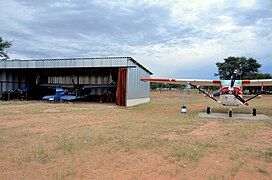
A hangar is a closed building structure to hold fly or romfartøy. Hangars are built of metal, wood, or concrete. The word hangar comes from Middle French hanghart ("enclosure near a house"), of Germanic origin, from Frankish haimgard ("home-enclosure", "fence around a group of houses"), from haim ("home, village, hamlet") and gard ("yard"). gard comes from the Old Norse garðr ("enclosure, garden").
Hangarer brukes til beskyttelse mot været, direkte sollys og til vedlikehold, reparasjon, produksjon, montering og lagring av fly.
Innhold
Historie
 | This article needs additional citations for bekreftelse. Please help forbedre denne artikkelen by legge til sitater til pålitelige kilder. Ukildemateriale kan bli utfordret og fjernet. Finn kilder: "Hangar" – nyheter · aviser · bøker · lærd · JSTOR (august 2019) (Finn ut hvordan og når du fjerner denne malmeldingen) |
 The Wright Flyer outside the aircraft's makeshift hangar
The Wright brødrene stored and repaired their aircraft in a wooden hangar constructed in 1902 at Drep Devil Hills in Nord-Carolina for their glidefly. After completing design and construction of the Wright Flyer in Ohio, the brothers returned to Kill Devil Hills only to find their hangar damaged. They repaired the structure and constructed a new workshop while they waited for the Flyer to be shipped.
 Carl Richard Nyberg's hangar for his Flugan (fly) from 1908, Täcka udden in Lidingö, Sverige
Carl Richard Nyberg used a hangar to store his 1908 Flugan (fly) in the early 20th century and in 1909, Louis Bleriot crash-landed on a northern French farm in Les Baraques (between Sangatte and Calais) and rolled his monoplan into the farmer's cattle pen. Bleriot was in a race to be the first man to cross the engelsk kanal in a tyngre-enn-luft aircraft, and he and set up his headquarters in the unused shed. In Britain, the earliest aircraft hangars were known as flyskur, and the oldest survivors of these are at Larkhill, Wiltshire. These were built in 1910 for the Bristol School of Flying and are now Grade II Fredede bygninger. British aviation pioneer Alliott Verdon Roe built one of the first aeroplane sheds in 1907 at Brooklands, Surrey and full-size replicas of this and the 1908 Roe biplane are on display at Brooklands Museum.
As aviation became established in Britain before World War I, standard designs of hangar gradually appeared with military types too such as the Bessonneau hangar and the side-opening aeroplane shed of 1913, both of which were soon adopted by the Royal Flying Corps. Examples of the latter survive at Farnborough, Filton and Montrose airfields. During World War I, other standard designs included the RFC General Service Flight Shed and the Admiralty F-Type of 1916, the General Service Shed (featuring the characteristic Belfast-truss roof and built-in various sizes) and the Handley Page aeroplane shed (1918).
Konstruksjon
Stålkonstruksjonredigere
Sheds built for rigid airships survive at Moffett Field, California; Akron, Ohio; Weeksville, North Carolina; Lakehurst, New Jersey; Santa Cruz flyvåpenbase in Brazil; and Cardington, Bedfordshire. Stålstive luftskiphangarer er noen av de største i verden.
Hangar 1, Lakehurst, is located at Naval Air Engineering Station Lakehurst (formerly Naval Air Station Lakehurst), New Jersey. The structure was completed in 1921 and is typical of airship hangar designs of World War I. The site is best known for the Hindenburg disaster, when on May 6, 1937, the German airship Hindenburg crashed and burned while landing. Hangar No.1 at Lakehurst was used to build and store the American USS Shenandoah. The hangar also provided service and storage for the airships USS Los Angeles, Akron, Macon, as well as the Graf Zeppelin and the Hindenburg.
The largest hangars ever built include the Goodyear Airdock measuring 1,175x325x211 feet1 and Hangar One (Mountain View, California) measuring 1,133 ft 308 ft 198 ft (345 m 94 m 60 m). The Goodyear Airdock, is in Akron, Ohio and the structure was completed on November 25, 1929. The Airdock was used for the construction of the USS Akron and her sister ship, the USS Macon.
Hangar One at Moffett Federal Field (formerly Naval Air Station Moffett Field), is located in fjellutsikt, California. The structure was completed in 1931. It housed the USS Macon.
Stoffkonstruksjon
Main article: CargoLifter
A hangar for Cargolifter was built at Merkevare-Briesen Airfield 1,180 ft (360 m) long, 705 ft (215 m) wide and 348 ft (106 m) high and is a free standing steel-dome "barrel-bowl" construction large enough to fit the Eiffeltårnet on its side. The company went into insolvens and in June 2003, the facilities were sold off and the luftskip hangar was converted to a 'tropical paradise'-themed indoor holiday resort called Tropiske øyer, som åpnet i 2004.
An alternative to the fixed hangar is a portable shelter that can be used for aircraft storage and maintenance. Portable stoffstrukturer can be built up to 215 ft (66 m) wide, 100 ft (30 m) high and any length. They are able to accommodate several aircraft and can be increased in size and even relocated when necessary.referanse trengs
Strukturer og størrelser
Hangarer trenger spesielle strukturer for å bygges. Bredden på dørene må være stor; dette inkluderer inngangen til flyet. Jo større fly som skal introduseres, desto mer kompleks er en struktur nødvendig. I henhold til hangarens spennvidde kan størrelser klassifiseres slik:
| Størrelse | Spenn (meter) |
|---|---|
| S | Mindre enn 30 m |
| M | 30–60 m |
| L | 60–90 m |
| XL | 90–120 m |
| XXL | Mer enn 120 m |
XXL hangars are built for the largest aircraft in the world like the Airbus A380, Boeing 747 and the Antonov 225, som er de mest komplekse å bygge.4
Regulering
Hangarer er vanligvis regulert av byggeforskriftene i landene og jurisdiksjonene og flyplassene der de bor. I august 2014 foreslo den amerikanske FAA lovgivning om hvordan en hangar kan brukes på flyplasser som mottar statlig finansiering. Definisjonen av tillatte aktiviteter inkluderte sluttmontering av fly.5
Luftskipshangarer
Luftskipshangarer or airship sheds are generally larger than conventional aircraft hangars, particularly in height. Most early airships used hydrogen gas to provide them with sufficient buoyancy for flight, so their hangars had to provide protection from stray sparks to keep the gas from exploding. Hangars that held several airships were at risk from chain-reaction explosions. For this reason, most hangars for hydrogen-based airships were built to house only one or two such craft. During the "Golden Age" of airship travel from 1900, mooring masts and sheds were constructed to build and house airships. The British government built a shed in Karachi for the R101, the Brazilian government built one in Rio de Janeiro, the pt: Hangar do Zeppelin for the German Zeppelinere, and the U.S. government constructed Moffett Field, fjellutsikt, California and Lakehurst Naval Air Station, Lakehurst, New Jersey.
Hangarer ombord på skip
 The helicopter hangar of an Akizuki-klasse ødelegger.
Many krigsskip carry aircraft and will often have hangars for storage and maintenance. Such hangars may be situated adjacent to the flydekk on kryssere, ødeleggere and fregatter or underneath the flight deck with heiser to lift the aircraft on hangarskip and amfibiske angrepsskip. På noen fartøyer hvor det er kort plass deler hangaren og flydekket samme plass, med hangaren oppbevart for flyoperasjoner.
Galleri
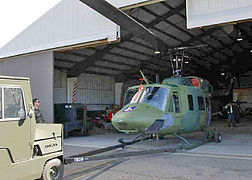
Hangars can hold faste-fly, roterende-vingefly (helikoptre), and lettere-enn-luftskip.
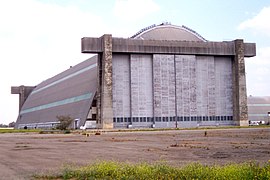
Hangar nr. 2 at the former Marine Corps Air Station Tustin is 1,072 ft (327 m) long, 292 ft (89 m) wide and 192 ft (59 m) tall.

En Airbus A319 under vedlikehold i en hangar.
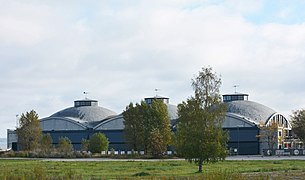
Hangars for sjøfly of the Det keiserlige russiske luftvåpenet in Tallinn harbor - some of the first armert betong structures

A General Dynamics F-16 Fighting Falcon in front of a Herdet Aircraft Shelter, en spesiell type hangar
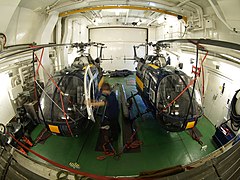
Helicopter hangar of the German research vessel Polarstern

A medium-sized aircraft hangar at Kemble flyplass, England

Hangar of Iberia Airlines (XXL-150m span) Barcelona flyplass, Spania
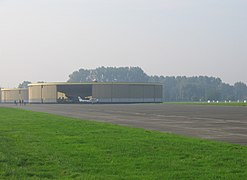
Round concrete hangars at Grimbergen flyplass, Belgia.